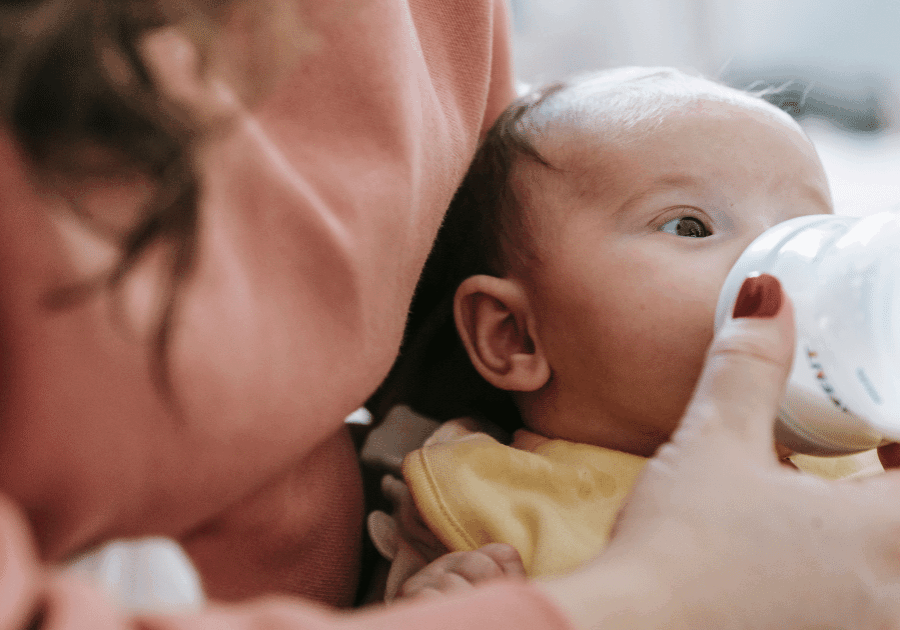
Paced Bottle Feeding
Metropolitan Doulas
Many parents use bottles to feed their infants milk and/or formula. As postpartum doulas, we see families use bottles as a primary method of feeding (if breastfeeding is not possible or desired), use bottles as a temporary option (if the lactating parent needs a nap or feels sore, for example), or use bottles as a transition when returning to work.
There is more to a bottle than tipping a baby back, inserting the nipple into their mouth, and holding position until a feed is done. Studies and anecdotal evidence suggest an alternative — paced bottle feeding — is more beneficial to babies, regardless of whether a bottle is their only, temporary, or transitional source of food.
What does Paced Bottle Feeding Mean?
Paced bottle feeding is responsive. From when to feed (look for hunger cues) to the baby’s position, the bottle’s angle, the level of food in the nipple, and the length of the feed, pacing responds to babies in real time. The baby, not the caregiver, leads; they control flow as they suck and swallow, take breaks to breathe when they need, and stop or signal fullness when they are done.
This sequence contrasts with traditional bottle-feeding practices that encourage babies to feed at a certain rate or finish a certain volume at every feed.
Are there Benefits to Paced Bottle Feeding?
Paced bottle feeding does not limit food or teach a baby to eat less. It helps them tune into their body’s signals, which, in turn, has several benefits. Here are some key ones.
- Baby-led and like breastfeeding, paced bottle feeding helps babies learn and coordinate the suck-swallow-breathe sequence. This is important for safety, including for breathing.
- Pacing bottles can make eating less stressful because babies control the speed and amount of food going into their little tummies. This can also help with digestion.
- The position of the baby when pacing is associated with fewer ear infections.
- Over time, paced babies may develop healthier eating habits as they understand hunger and fullness and learn to trust their own instincts and needs on both.
Watch the Baby, not the Clock: How To Pace Bottle Feed
When pacing a bottle, begin feeding when a baby starts showing signs of hunger. Rooting and sucking, for examples, are early hunger cues. Crying is a late hunger cure.
- Hold the baby in a semi-upright or upright position with full head and trunk support. Avoid laying them flat on their back or with their neck flexed towards their chest.
- Invite a latch by gently touching the nipple to the baby’s lips. Wait for the baby to open their mouth rather than inserting the bottle into the mouth.
- Use the smallest size nipple or a slow-flow nipple that is age appropriate. For some babies, this might mean using a preemie nipple even though they are not premature. (The nipple size is based on the hole at the tip, not the size of the whole nipple.)
- Hold the bottle horizontally, not tipped at a steep angle, so the nipple well is partially filled. This reduces gravity-driven flow and encourages active baby-led sucking. The nipple should have milk at the tip, but there’s no need to tip the bottle to fill the nipple chamber with milk. In fact, sucking on an empty nipple will not automatically fill a baby with gas — sucking on air does not mean swallowing air.
- Take a break after a few sucks and swallows. Tip the bottle down so the nipple is no longer full but keep it in the baby’s mouth. This creates a natural pause to breathe, swallow, and re-engage with the nipple when they feel ready.
Other Considerations in Paced Bottle Feeding
- Look for cues. If the baby re-engages with the nipple after a pause, continue feeding; if the baby shows signs of distress (wide eyes, spitting, coughing, etc.), take a break or slow the flow of milk; if the baby shows signs of fullness (relaxed body, longer breaks, distraction, sleepiness, etc.), stop. Remember, like babies at the breast, babies on bottles take frequent pauses between swallows. Plus, they don’t have to finish every drop of every bottle!
- Time the feeding to last 10-15 minutes, the approximate time of a breastfeeding session. Though it can be convenient for a feeding to go quickly, eating too fast means that infants may take in more than they need to be satisfied. We want them to learn to eat to satiety.
- Switch sides halfway through the bottle. Babies learn habits quickly and it is important to give them a variety of poses for eating. This encourages flexibility in feeding and symmetrical development of eye focus and muscle coordination.
What about Nipple Confusion?
We hear from parents concerned about periodic bottle use that their infant may develop “nipple confusion.” Paced bottle feeding can help prevent nipple confusion, which may more accurately be called “flow preference.” If bottle feeding mirrors the experience, pace, and quantity of breastfeeding, it can be easier for babies to switch back and forth.
Resources on Paced Bottle Feeding
There are lots of videos online that can help parents with paced bottle feeding. This is one of our favorites.
For a deeper dive, an article by Solid Starts covers the benefits, steps, and common mistakes caregivers make when pacing bottles and research published in the journal, Early Human Development, highlights the impact of pacing and caregiver responsiveness on babies.
Finally, if you have questions about this or other bottle, pumping, or breastfeeding issues, please give us a call. Metropolitan Doulas is here to help.
Last edited: May 21, 2026
